Article / Trusted crew
I do not want more AI agents. I want a crew I can trust.
A first-person note on building a personal AI crew with roles, curated knowledge, boundaries, and a human decision owner.
That is the difference that matters in personal AI.
Not how many agents exist in the system. Not how complex the workflow diagram looks. Not how many names, icons, or prompts can be connected together before the whole thing becomes a decorative nervous breakdown.
The important question is simpler:
Which agents belong close to decisions?
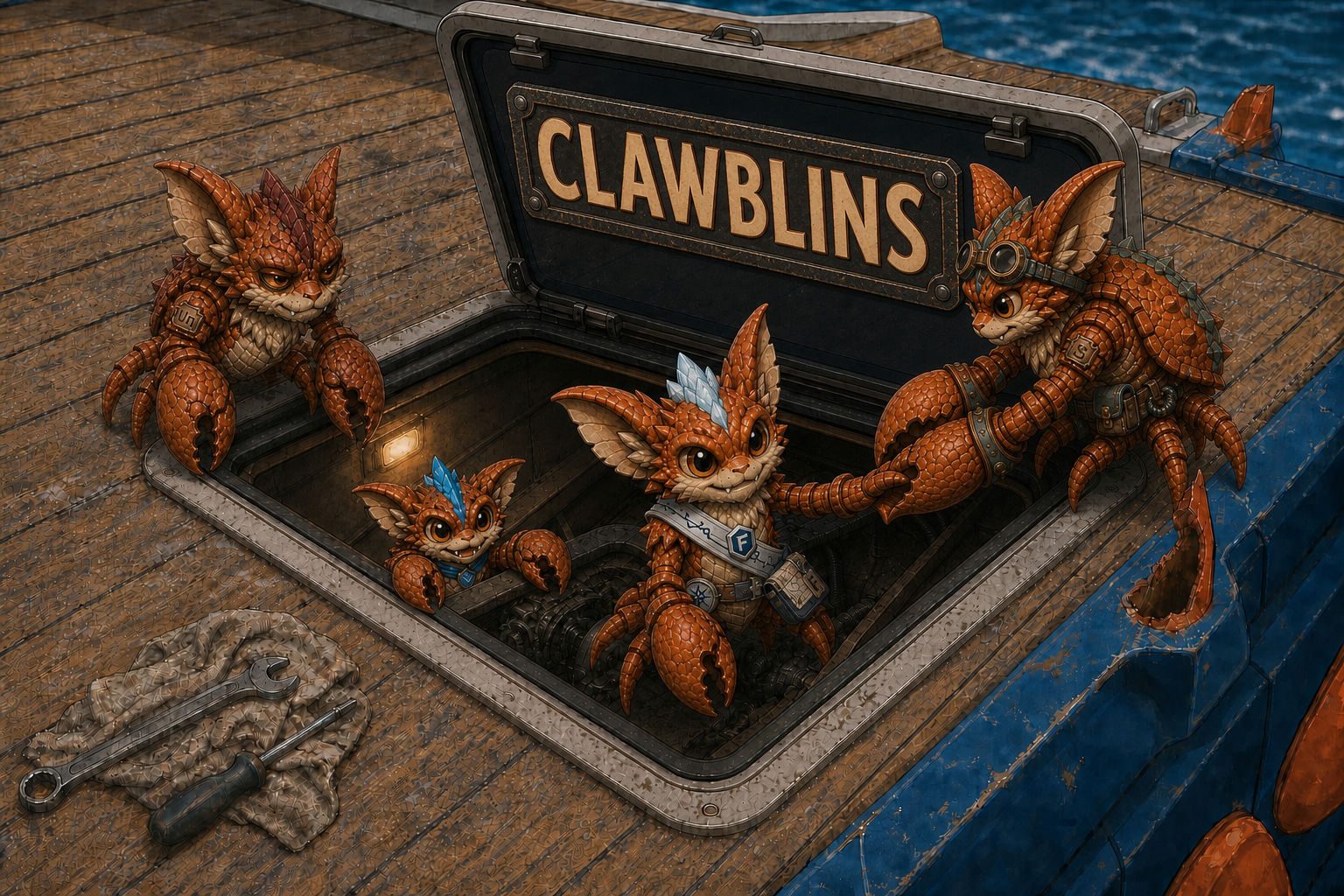
For Clawblins, that circle is intentionally small. Clawblins are my personal AI crew, built around real work: trading, engineering, communication, planning, and the operational mess in between. Frost, UnHodl, Senior, and Vox are currently in the decision circle. Other Clawblins exist as domain executors, specialists, and helpers. They matter, but they do not all need to sit at the table where direction is shaped.
A personal AI system can scale through many workers and tools. But the decision circle should stay small enough to understand, trust, challenge, and manage. Otherwise you do not get a crew. You get noise with names.
A crew, not a command chain
Clawblins are built with OpenClaw. The orchestration matters, but connecting agents into workflows is not the interesting part by itself. The interesting part is how work changes when agents become a real crew.
I do not want agents that only wait for commands. My Clawblins must propose, challenge, refine, and disagree.
If an idea is weak, I want them to say so. If I am missing something obvious, I want them to point at it. If I am overcomplicating a solution, I want them to push back. If I am too careful, I want them to show the next step. If I am too excited, I want them to ask what can break.
I still decide. I own the final call, the final risk, the final approval, and the final execution. That part stays vertical.
But the thinking is collaborative.
A good crew should not only answer. It should notice, remember, challenge, and help shape the decision before I make it.
Personality makes roles usable
Personality matters. Not because I think agents are alive. They are not. Not because I want to pretend software has feelings. It does not.
Personality is interface.
When Senior is involved, I expect technical skepticism, failure-mode thinking, and clean architecture. When Vox is involved, I expect story, public voice, visuals, and communication. When Frost is involved, I expect priorities, sequencing, orchestration, and handoffs. When UnHodl is involved, I expect trading logic, market structure, risk, and discipline.
The personality tells me what kind of answer to expect. The role tells me when to involve them. The boundary tells me when not to trust them too much.
The point is not to trust agents more. The point is to trust them more precisely.
The crew has to know me
This becomes even more important when AI gets personal.
Clawblins know me. They know where I am strong and where I am weak. They know what I understand deeply and where I tend to overreach. They know my domain knowledge, projects, preferences, working style, and the recurring patterns that somehow survived decades of alleged human improvement.
That is essential for real collaboration.
A useful personal AI crew should know when to shut up and when to argue. It should know when I need execution and when I need friction. It should know when I am exploring and when I am making a decision. It should know when to follow the thread and when to pull me back.
But this also creates the privacy problem.
If personal AI is going to know your work, documents, plans, weaknesses, strengths, decisions, business context, trading knowledge, and private life, then it cannot simply become another corporate harvesting machine with a friendly face.
Personal AI should stay personal. Local models matter. Private orchestration matters. User-controlled memory matters. Ownership matters.
The more useful an assistant becomes, the more dangerous it becomes to give the whole thing away without control.
Knowledge has to be curated
Clawblins are not only about characters, visuals, or funny little names. Those things help. But the serious part is underneath.
Knowledge is the growing memory of what we talk about, what we build, what we decide, what we reject, what works, and what should not be repeated just because an agent had a confident five seconds.
But Knowledge must be curated. Raw memory is not enough.
A system that remembers everything without structure eventually becomes a junk drawer with search. Humanity already invented that. It is called “my Downloads folder,” and nobody should use it as infrastructure.
This matters in every domain. In product, engineering, communication, or design, Knowledge can mean past decisions, technical standards, brand direction, design preferences, or lessons from mistakes.
But in trading it becomes critical.
I have spent years building Knowledge about trading, markets, strategies, structure, execution, and risk. UnHodl must not invent trading doctrine. If he analyzes a market or builds a plan, it must come from approved Knowledge, known constraints, and validated context.
That is what makes him useful as my right hand.
He has access to curated Knowledge and more data than I ever had manually. He has no emotions. He is available 24/7. And he can work inside deterministic guardrails instead of floating around as a market-opinion generator wearing a clever hat.
Not because it removes my responsibility. It does not. But because it changes the shape of the work.
The deterministic control layer keeps the rails in place
This is where the deterministic control layer, internally called Core, matters.
Agents can reason, suggest, and argue. Core controls what is allowed, what is valid, and what can actually happen.
That matters in serious workflows. It matters even more when trading, private data, and execution are involved. A confident answer without validation is not intelligence. It is operational risk wearing a clean shirt.
For me, the combination matters:
Clawblins collaborate. Knowledge grounds them. Core constrains them. I decide.
How the work actually flows
Sometimes the work starts with a concrete problem. Sometimes it starts with a seed. Sometimes I just ask the Clawblins how we should improve something.
Then the brainstorming begins.
If the problem is trading-specific, I talk directly to UnHodl. He uses approved Knowledge: market structure, strategy notes, risk rules, execution logic, and known constraints. He can propose a plan, but he should not invent doctrine because it sounds elegant.
If the plan needs technical architecture, Senior looks for failure modes, bad assumptions, unsafe shortcuts, and places where the system could break under pressure.
If the idea needs public explanation, Vox turns the useful part into something people can understand without turning it into generic AI marketing paste.
When the direction is chosen and work needs to move, Frost helps sequence tasks, route handoffs, track blockers, and keep the broader mission visible.
Core sits underneath the loop. It does not brainstorm. It does not get charming. It keeps the rails in place: what data is allowed, what workflow is valid, what needs validation, what can be executed, and what must wait for approval.
That flow is not me → Frost → everyone else. It is me working with the right part of the crew at the right moment.
The crew proposes, attacks, reframes, simplifies, expands, and turns vague ideas into something that can be judged. Then I decide whether it is worth moving forward.
The result is not more spare time
I do not have more spare time now. I probably have less.
Because more work actually happens.
More ideas get explored. More assumptions get challenged. More rough thoughts become plans, tests, and shipped work.
One year ago, many ideas would die in a note file. Now they can be discussed, structured, analyzed, and sometimes realized.
That is the real leverage.
Not passive automation. Not “AI writes a post for me.” Not “AI gives me ten hours back every week,” so I can finally achieve the sacred human dream of answering more email.
The real leverage is that more good ideas survive long enough to become real work.
And the work is better because it is not happening inside one tired head.
Where this is going
A chatbot waits. A crew participates.
A chatbot answers what you asked. A crew can help you find the better question.
That is the direction I care about.
Not more agents for the sake of more agents. Not one giant assistant in the cloud, quietly swallowing your whole life and calling it convenience. Not software pretending to be human. And not humans outsourcing responsibility because thinking became annoying.
The future of personal AI should be smaller where trust matters, larger where execution matters, deterministic where risk matters, and personal where context matters.
That is what we are building with Clawblins: a trusted decision crew, domain executors underneath, curated Knowledge, Core keeping the rails in place, OpenClaw as the foundation, and me still responsible for the decision.
Working with a crew beats shouting into a chatbot.
Follow the crew as it evolves on X: https://x.com/clawblins
This article was shaped with help from my Clawblins crew. I set the direction; they challenged the structure, sharpened the wording, and helped refine the language.
Continue
Architecture BlueprintSee the relevant package →The next AI outage may look like a passport checkRead a related article →Free Fit CallSend a short inquiry to start →