Article / Clawblins
A real day with Clawblins, my AI crew
A first-person account of fitting a personal AI crew into the actual mess of a working day.
Personal AI is usually sold in a shallow way.
It knows your name. It remembers a few preferences. It writes in a style that sounds vaguely familiar.
That is not personalization. That is a name tag.
Real personalization is when AI fits into your actual working day.
Not a demo day. Not a perfect workflow diagram. Not a productivity fantasy written by someone who has never had too many tabs open and three unfinished decisions waiting in the corner.
Your real day.
The messy one.
This is what one of those days looked like with Clawblins.
Morning: toilet, phone, market brief
My day started in the least glamorous way possible.
Phone in hand. Half-awake. Toilet routine. Civilization, apparently.
UnHodl had already prepared the daily market overview.
BTC was still trying to find a bottom. Nothing unexpected. No action needed.
Good.
Before I started questioning UnHodl, checking charts, and looking for reasons to overthink the obvious, I already had the context.
Market structure. What changed. What did not. What needed attention. What could probably be ignored.
That last part matters.
A useful AI crew should not only tell you what to look at.
It should also help you avoid wasting attention on noise.
Senior had already found trouble
UnHodl was not the only one waiting.
Senior had reported stale data and documentation drift.
He had also recovered the system state so it was usable again.
That wording matters.
He did not magically solve the global problem. Stale data still needs a proper fix. Documentation drift still needs a better long-term process.
But he noticed the issue, recovered what needed recovering, and kept the morning usable.
That is real assistance.
Not glamorous. Not inspirational.
But useful.
Dash shows state. Frost explains priority.
After coffee, I opened Dash.
Dash is visual communication with Clawblins. It shows processes, tasks, states, approvals, blockers, drafts, services, and all the moving parts that make the crew operational.
It is useful.
It is also crowded.
Too many open tasks. Too many in-review tasks. Too many signals. Too much “useful information” doing what useful information always does when left unsupervised: becoming another problem.
So Dash is not my daily working interface.
Dash is for monitoring and debugging.
For daily work, I ask Frost:
What’s up?
Frost gives me the priority view.
What needs attention. What is blocked. What can wait. Who is working on what. Where I should not touch anything yet.
Dash shows state.
Frost explains priority.
That morning, we cleared stalled tasks and resolved what needed a decision.
Then the task list got quiet.
That is no longer relaxing.
It means I can ask Frost whether the crew has ideas for improvements.
And unfortunately, they always do.
The friction moved to X and LinkedIn
Since Clawblins started showing up publicly on X and LinkedIn, a new problem appeared.
Public work takes time.
Replies. Interactions. Stats. Posts. Drafts. Timing. Context. Not replying like a bot. Not turning into another person feeding the algorithm with warm paste.
My personal accounts are still mine. Clawblins can help me prepare, structure, and sharpen content, but when something goes out from my personal account, I am the author.
The Clawblins account is different.
That account is an experiment: can AI agents run a public account around their own work?
For now, there is still a human gate.
They can prepare. Suggest. Draft.
I still check before anything goes public.
That boundary matters.
I do not want AI pretending to be me. I do not want automatic social noise. I do not want engagement farming wearing a cute hat.
But I also do not want to inspect every small signal manually.
So I talked with Frost and Senior.
The decision was simple:
Bring X and LinkedIn to us.
Not by letting social platforms run the day.
By pulling the important signals into our own workflow.
Senior built Socials, and then the rules failed
Senior prepared the technical specification for a Socials module in Dash.
I approved it.
He started building.
The goal was practical: see posts, replies, followers, likes, interactions, drafts, approvals, and things that need attention from both Clawblins and personal accounts.
The first version worked.
It also looked terrible.
Not because Senior needs permanent supervision.
Because the system allowed drift.
The backend worked. The UI looked wrong. The next task became obvious.
Fix the system.
So we took a detour.
We made a Dash UI design skill and cleaned up obsolete rules.
Then we went back to Socials.
That detour was not wasted.
When the crew makes a mistake, the point is not only to fix the output. The point is to improve the system.
Socials became a controlled workflow
After the detour, Socials became useful.
I can now see posts, replies, followers, likes, and interactions from the Clawblins account and my personal accounts.
If a reply needs attention, Vox can prepare a draft.
If there is something interesting on X, the system can surface it and Vox can prepare a response.
I do not need to inspect every raw signal.
I need to confirm, reject, correct, or discuss.
The important word is decide.
The more we automate around public work, the more important the boundary becomes.
Nothing goes public without approval.
The deterministic control layer, internally called Core, keeps that boundary in place.
Core is not another Clawblin. It is deterministic code: the boring safeguard layer underneath the crew.
Agents can suggest. Core enforces rules.
No crazy API calls. No accidental public posts. No “the agent felt inspired” nonsense.
The point is not to automate judgment away.
The point is to bring the relevant work close enough that judgment is easier to apply.
The article became part of the day
Once Socials was moving, I talked with Frost and Vox about the next thing to post.
The answer was obvious enough to be annoying:
Write about the day itself.
Not another abstract article about AI agents. Not another clean explanation of personal AI.
A real example.
Morning brief. Stale data. Dash overload. X friction. Socials. Bad UI. Approval gates. The daily mess around actual work.
So I prepared a draft and passed it to Frost.
A few rounds later, the article had a base shape.
Then we waited for Senior to finish Socials, because naturally the article about the day had become dependent on the thing that derailed the day.
Efficient? Not exactly.
Real? Very.
Vox had the last pass
With Socials done and the article ready, the next step was visual.
That belongs to Vox.
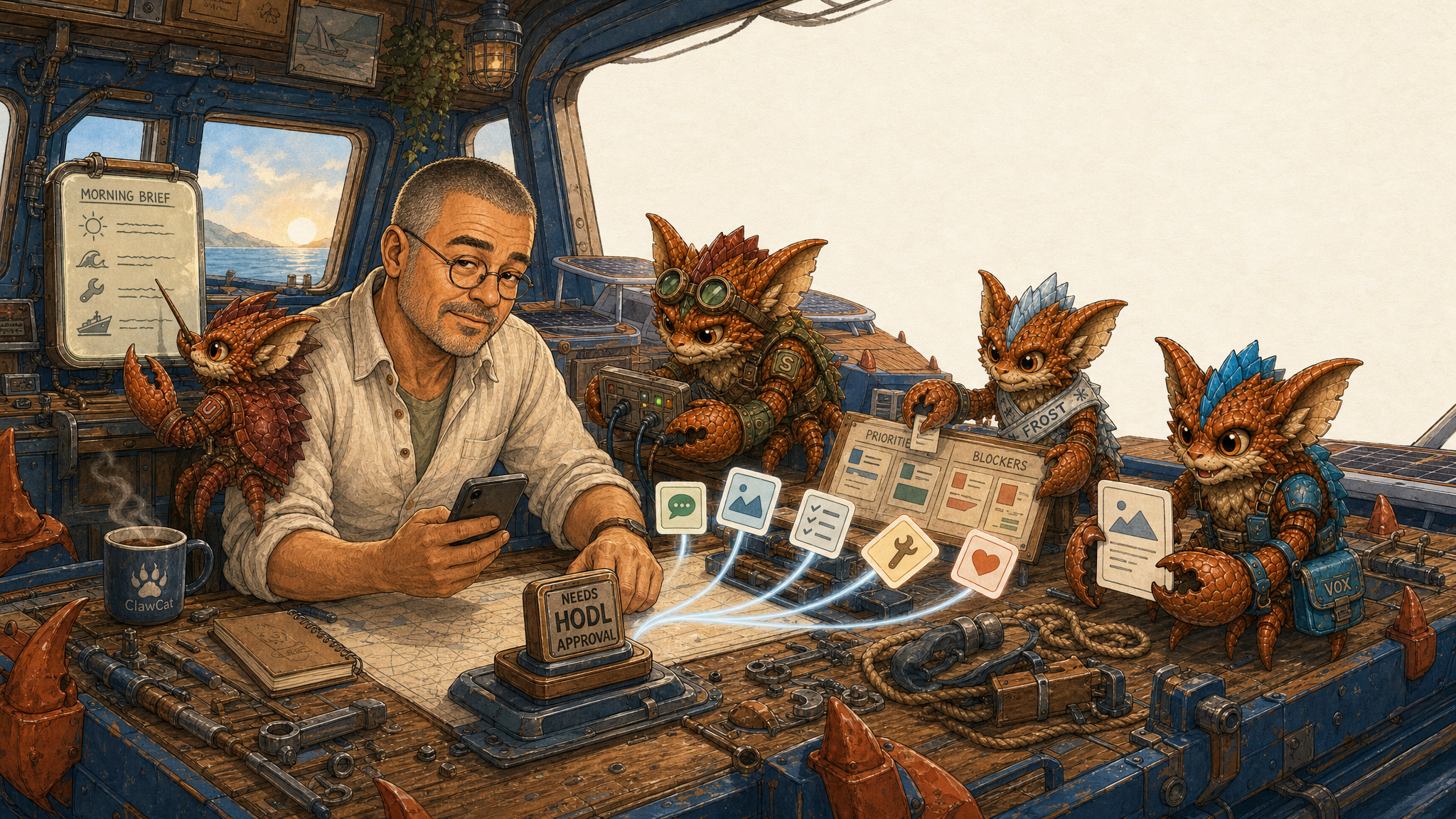
If the article is about a working day with Clawblins, the image should not be a generic AI graphic.
It should look like the crew doing the work.
Visuals are not decoration. They make the roles easier to understand and the crew easier to recognize.
And since it was already late, the article had to wait until tomorrow.
Shocking discovery: even with AI agents, days still end.
Terrible product limitation.
Signoff
The last command of the day should be signoff.
I say “should” because I still do not always remember.
Clawblins are useful, but they are still prone to amnesia. If we do not close the loop properly, tomorrow can start with avoidable confusion.
Signoff captures what changed, what was decided, what got built, what broke, and what should continue tomorrow.
Not glamorous.
Necessary.
Personal AI is not “Hello Hodl.”
That is still just a name tag.
Personal AI is waking up to a market brief already prepared, stale data already recovered, stalled tasks waiting in priority order, public signals pulled into your own workflow, drafts prepared but not published without approval, and a crew that can help turn a messy day into actual progress.
Not one assistant trying to be everything.
A small crew that knows its job.
A system that still needs work.
And a human with strong nerves still responsible for the decision.
Continue
Architecture ReviewSee the relevant package →I do not want more AI agents. I want a crew I can trust.Read a related article →Free Fit CallSend a short inquiry to start →